FC Blue Wings · Matchday
Big Bird Stadium: the Suwon Bluewings matchday guide, from tickets to the north end
Suwon Bluewings tickets are one of the few things in Korean football that are easier to buy in person than online, and Big Bird Stadium is easier to reach than its address suggests. This is the practical version: which train, which bus, which booth, which end.
Getting to Big Bird Stadium
The ground sits at 456 Uman-dong in Paldal-gu, north-east of central Suwon, which puts it a bus ride rather than a walk from the station. From Seoul, subway Line 1 runs to Suwon Station in about an hour, and the KTX covers the same distance from Seoul Station in just over thirty minutes.
From Suwon Station the simplest option is a bus: 86, 100, 720, 720-1 and 702-2 all pass Big Bird Stadium, as do the 13, 13-3 and 13-4. A taxi from the station takes ten to fifteen minutes and costs little by European standards. If you would rather stay on rail as long as possible, change to the Suin–Bundang line at Suwon Station and ride two stops to Suwon City Hall, then pick up a bus for the last stretch. Gwanggyo Jungang is the closest station on foot, but it is still a twenty-five to thirty minute walk, so it is worth it only if you want the approach.
On a matchday the surest navigation is the crowd. The walk-up from the bus stops thickens with blue shirts an hour before kick-off and leads straight to the gates.

Suwon Bluewings tickets, and why the booth beats the app
Korean ticketing runs through two platforms, Ticketlink and NOL Interpark. Both need a Korean mobile number to register, which puts advance online purchase out of reach for most visitors, and the interfaces are in Korean. This sounds like a problem and mostly is not one.
Suwon Bluewings tickets are sold the old-fashioned way instead, and so are everyone else's: all twenty-nine clubs in K League 1 and K League 2 sell at official booths outside their stadiums on the day. The booths carry English signage even where the staff do not speak much English, the seating map is displayed in the window so you can point at the section you want, no identification is asked for, and a processing fee of around 2,000 won is added. Bring a card: cash is not always accepted.
The caveat matters here more than almost anywhere else in the league. K League matches very rarely sell out, and this club is one of the named exceptions, so a full house is a real possibility rather than a theoretical one. For an ordinary league fixture, turning up an hour early is enough. For anything bigger, treat the booth as a fallback rather than a plan.
Two things this page deliberately does not print, because both move and a stale number is worse than none: the fixture list and the current ticket prices. Both come from the club, at bluewings.kr, and the league's own site, kleague.com, carries the full K League 2 schedule. Check the date before you book the train: home matches are usually weekend afternoons or evenings, but the calendar shifts with cup rounds and international breaks.
Where to sit on a matchday
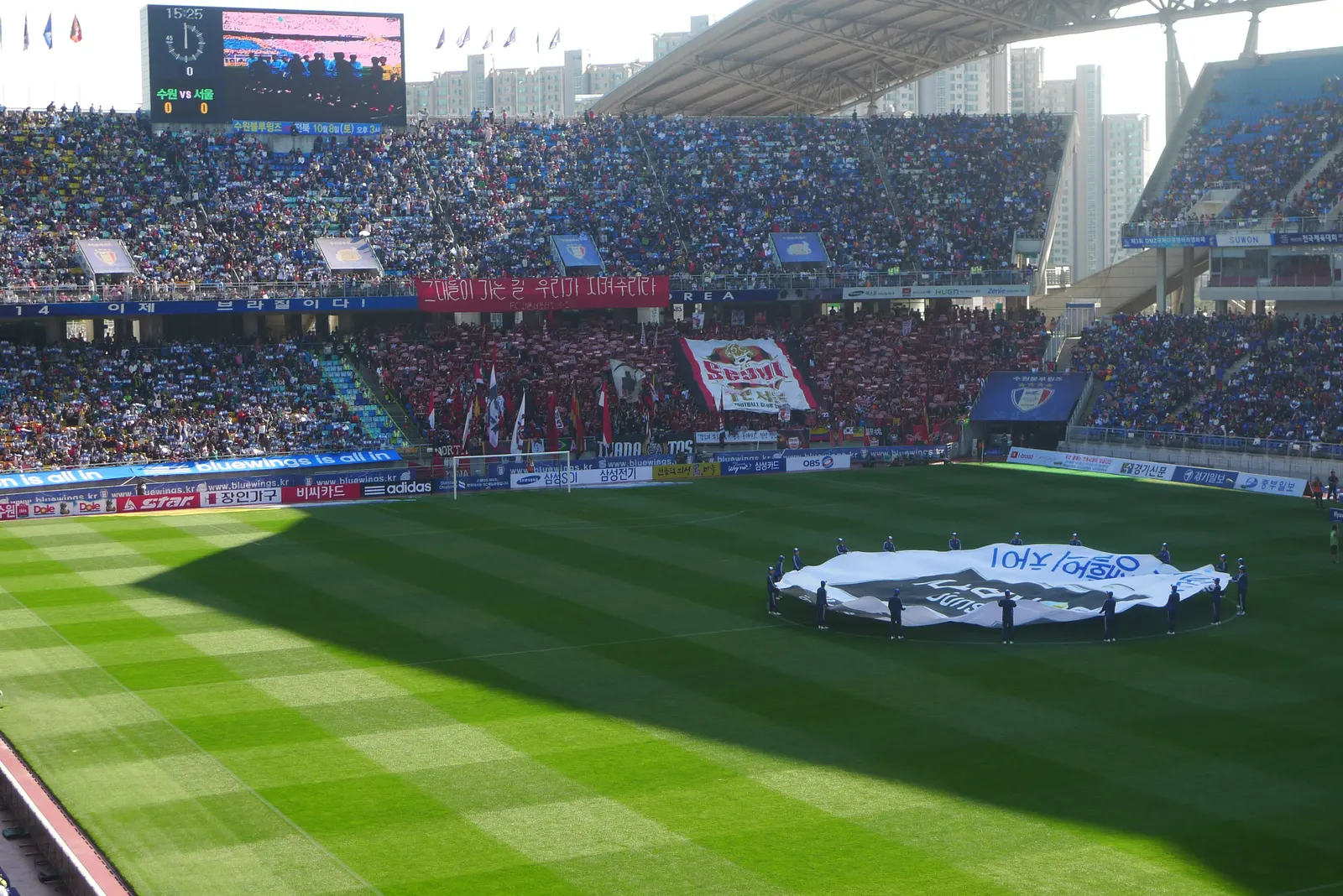
The N section behind the goal is Frente Tricolor's ground, and it is a standing, singing, ninety-minute commitment rather than a seat. Newcomers are welcome in it; the songs are call-and-response and the responses are short enough to pick up inside a half.
If you would rather watch the choreography than be inside it, the east side looks straight across at the north end and gives you the whole picture, cards and umbrellas and all. The corners are the compromise: close enough to hear the drums, far enough to sit down.
K League ground rules: colours, drink and bag checks
Two rules catch visitors out. Home clubs do not allow opposition merchandise in home sections, and away ends do not allow home colours, so a neutral top is the safe choice if you have not decided which end you are in. Beyond that the atmosphere is deliberately family-friendly, and alcohol is permitted in every K League stadium, including at your seat, which is not the case in much of Europe.
After the whistle in Ingye-dong
The post-match crowd leaves Big Bird Stadium for Ingye-dong and the streets around Ajou University, the two commercial centres of the city, where the restaurants and sports bars absorb whatever the result was. The order is chimaek, fried chicken and cold beer, which is less a suggestion than a local default.
What Suwon World Cup Stadium actually is
Suwon World Cup Stadium opened on 13 May 2001, designed by Samoo Architects & Engineers, and holds 44,031. The nickname comes from the roof: two great curved spans that read as wings from outside the bowl, hence Big Bird. Before it opened the club played at Suwon Sports Complex, which held 11,808, so the move multiplied the capacity almost fourfold.
It was built for the 2002 World Cup and staged four matches, including one of the tournament's knockout ties.
| Date | Match | Stage | Attendance |
|---|---|---|---|
| 5 June 2002 | United States 3–2 Portugal | Group D | 37,306 |
| 11 June 2002 | Senegal 3–3 Uruguay | Group A | 33,681 |
| 13 June 2002 | Costa Rica 2–5 Brazil | Group C | 38,524 |
| 16 June 2002 | Spain 1–1 Republic of Ireland, 3–2 on penalties | Round of 16 | 38,926 |
Scroll the table sideways to see every column.
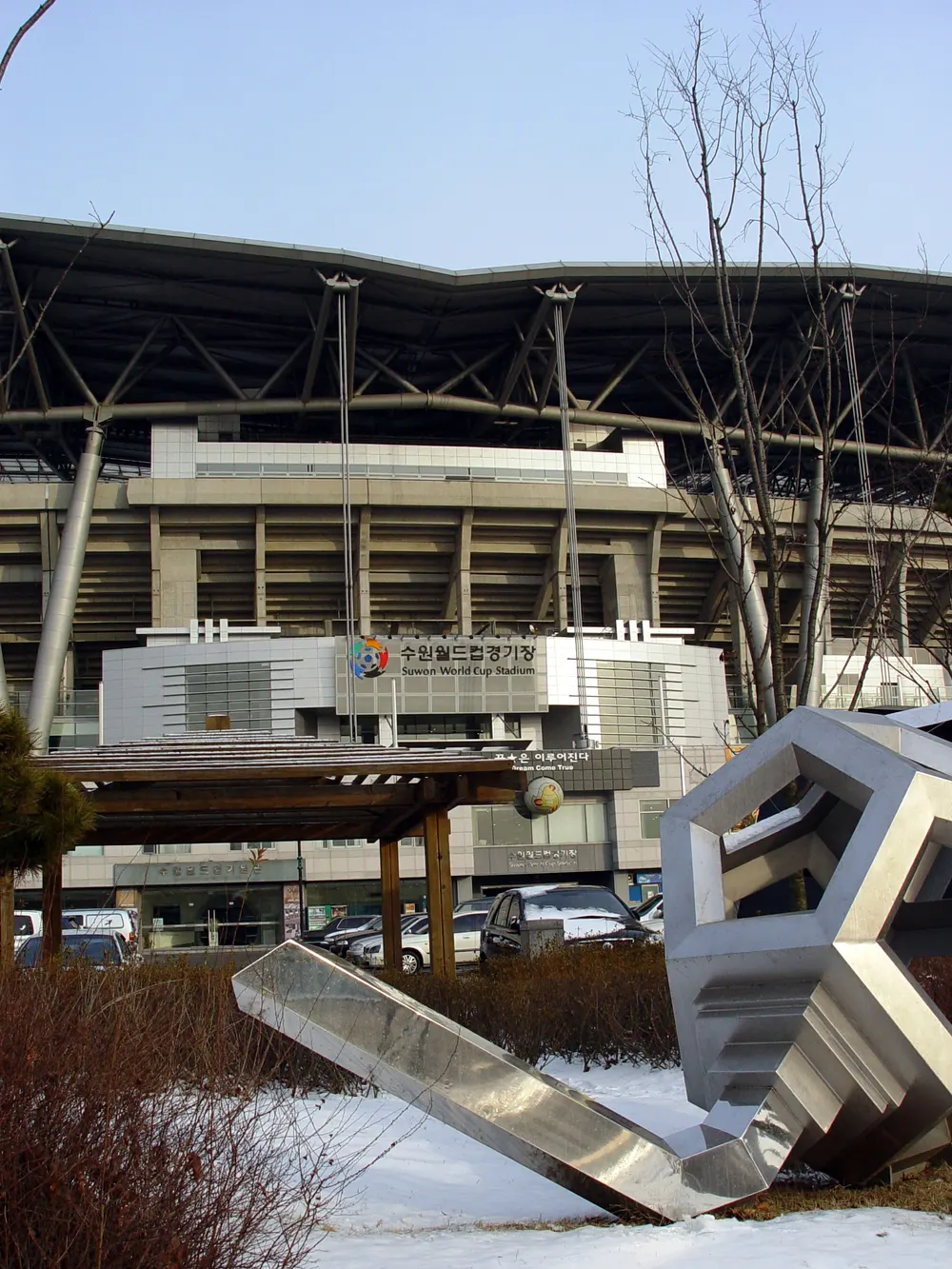

The ground also hosted the 2001 FIFA Confederations Cup and the 2017 FIFA U-20 World Cup. Its largest recorded crowd, 45,192, came at a Super Match against FC Seoul on 1 April 2012. The second-division record set here on 28 February 2026, when 24,071 watched the season opener against Seoul E-Land, says something about the support rather than the division.
Before you go
Can I buy a ticket at the stadium on the day?
Usually, yes. Every club in both divisions sells at booths outside the ground, no ID is asked for, and the processing fee is about 2,000 won. Card is safer than cash. This is one of the clubs that can sell out, so leave yourself margin.
How do I get there from Seoul?
Line 1 to Suwon Station takes about an hour, the KTX just over thirty minutes. Then bus 86, 100, 720, 720-1 or 702-2, or a ten to fifteen minute taxi.
Where do the home supporters stand?
The N section behind the goal. The east side gives the best view of it.
Can I drink at my seat?
Yes, alcohol is allowed in all K League grounds. What is not allowed is opposition merchandise in a home section, or home colours in the away end.
How big is the ground?
44,031 seats. The biggest crowd it has recorded is 45,192, for a Super Match on 1 April 2012.